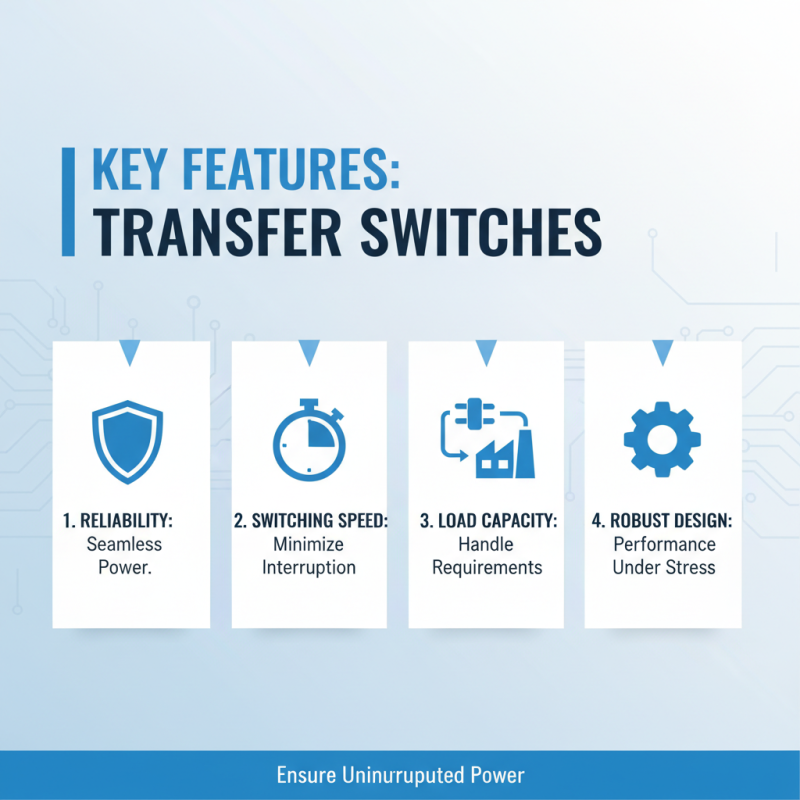
China Top 10 Transfer Switches for Reliable Power Solutions?
In today's world, reliable power solutions are crucial for both residential and commercial sectors. Transfer Switches play a pivotal role in ensuring uninterrupted power supply. A recent report by Markets and Markets highlights that the global Transfer Switch market is projected to reach $3.5 billion by 2026, growing at a CAGR of 6.1%. This growth underscores the increasing reliance on alternative power sources.
Expert James Harrison, a renowned figure in the Transfer Switch industry, emphasizes, “Investing in quality Transfer Switches is not only about efficiency but also about safety.” His insights reflect a growing consensus among experts that quality equipment can prevent costly downtime.
As we explore the top 10 Transfer Switches in China, it becomes essential to consider their features, reliability, and installation requirements. For many businesses, a Transfer Switch is not just an accessory; it's a lifeline. However, the market also presents challenges. Understanding the nuances is vital, as products may vary in quality and suitability. Investing time and research can significantly impact operational resilience.
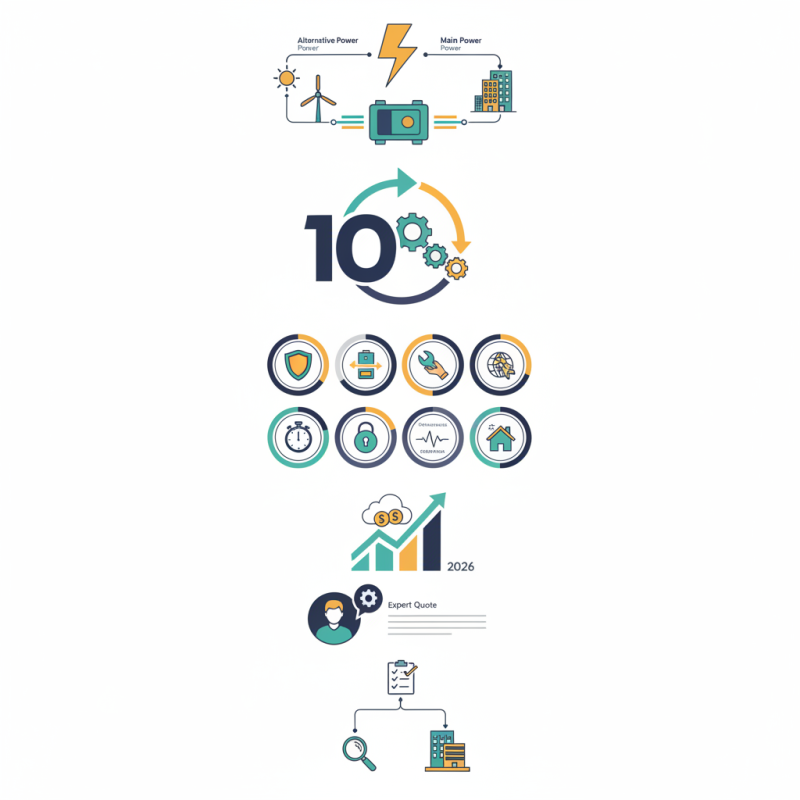
Overview of Transfer Switches and Their Importance in Power Solutions
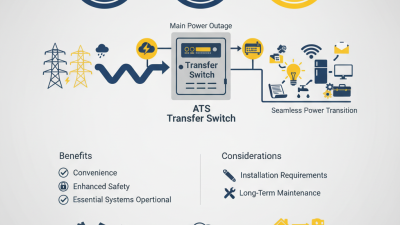
Transfer switches play a crucial role in power solutions. They ensure that electrical power is seamlessly transferred between two sources. This is vital for maintaining continuous power supply during outages. Without these devices, businesses and homes may face significant disruptions.
In essence, a transfer switch acts as a bridge. It automatically connects backup generators when the primary power fails. This system helps prevent damage to equipment. However, not all transfer switches are created equal. Some may lack reliability, which can lead to critical failures. It's essential to consider factors like load capacity and response time.
When selecting a transfer switch, it’s important to evaluate safety features. Underestimating this can lead to accidents or malfunction. Regular maintenance is also necessary to ensure performance. Neglecting routine checks can result in unexpected failures. A well-maintained transfer switch will protect against power interruptions effectively.
Top 10 Transfer Switch Brands in China: A Comparative Analysis
When selecting reliable power solutions, understanding transfer switches is critical. These devices ensure seamless power transition, especially during outages. In China, many brands compete to provide effective options tailored for various needs. These switches vary in design, functionality, and overall performance.
A comparative analysis of the top brands reveals distinct characteristics. Some prioritize durability under extreme conditions, while others focus on advanced technology for ease of use. However, not all switches perform equally well in every scenario. Understanding each switch's limitations is essential. Users may find that some models lack specific features, making them less effective during emergencies.
Testing these devices can lead to valuable insights. Practical experience reveals that regular maintenance is critical for optimal performance. Environmental factors, such as humidity and temperature, also affect reliability. Some brands may not withstand harsh conditions. Users must consider these aspects before making a choice. A thorough evaluation can ensure a more dependable power solution tailored to individual requirements.
Applications of Transfer Switches in Various Industries
Transfer switches play a vital role in ensuring reliable power across various industries. In healthcare, for example, they are crucial for uninterrupted power supply to life-saving equipment. Hospitals depend heavily on these switches during outages to maintain operations. A failure in such settings can have dire consequences, highlighting the need for dependable solutions.
In commercial sectors, data centers utilize transfer switches to guarantee continuous operations. These centers house critical data and require immediate switching to backup power sources. Any delay could lead to data loss or service interruptions. It's also important to regularly test and inspect these switches. Failure to do so can result in unexpected power failures.
Manufacturing facilities also benefit from transfer switches. Equipment downtime can lead to financial losses. Inconsistent power supply can disrupt production processes. Therefore, having a reliable transfer switch is essential. Identifying areas for improvement in these systems can prevent costly errors. Regular assessments ensure that these switches perform effectively in critical situations.
China Top 10 Transfer Switches for Reliable Power Solutions
| Model |
Voltage Rating (V) |
Current Rating (A) |
Number of Poles |
Application Industry |
| TS-1000 |
400 |
1000 |
3 |
Healthcare |
| TS-2000 |
480 |
2000 |
3 |
Industrial |
| TS-3000 |
220 |
3000 |
1 |
Commercial |
| TS-4000 |
600 |
4000 |
4 |
Data Centers |
| TS-5000 |
240 |
5000 |
2 |
Telecommunications |
| TS-6000 |
480 |
6000 |
3 |
Manufacturing |
Future Trends in Transfer Switch Technology and Reliability
The future of transfer switch technology is evolving rapidly. As industries demand more reliable power solutions, innovations are emerging. Smart transfer switches are gaining traction, using sensors and IoT connectivity. These features allow real-time monitoring and improved response during outages. The integration of predictive analytics further enhances their reliability.
Manufacturers are focusing on durability and efficiency while keeping costs manageable. New materials are being tested for better longevity and performance. However, challenges remain. The accuracy of sensors can vary, and system malfunctions still occur. Continuous advancement is needed to address these issues.
User-friendly interfaces are also becoming important. In emergencies, operators need quick access to information. Training is essential for effective use of these advanced systems. Despite these improvements, the reliance on technology can be a double-edged sword. Over-automation may lead to complacency among human operators, highlighting the need for balance.
China Top 10 Transfer Switches for Reliable Power Solutions






 Claire
 Mr.Fu
Mr.Fu

 Claire