Top Rmu Circuit Breaker Features You Need to Know?
In the ever-evolving field of electrical engineering, the importance of the RMU Circuit Breaker cannot be understated. Industry expert Dr. Jane Smith emphasizes, "Understanding the features of RMU Circuit Breakers can significantly enhance safety and reliability." This statement highlights a critical theme in today’s energy management landscape.
RMU Circuit Breakers are at the forefront of ensuring electrical systems operate smoothly and securely. Their design incorporates advanced technology aimed at minimizing downtime. However, one must consider that not all RMU Circuit Breakers are created equal. Adapting to specific environments can present challenges. Therefore, knowledge of their key features becomes vital for engineers and technicians.
Moreover, as the sector grows, new features emerge, but they can also lead to confusion. Many professionals struggle to keep up with these advancements. Enhanced protective mechanisms, for instance, provide benefits but require careful implementation. This balancing act is essential for maintaining optimal performance and safety in power distribution systems.

Key Features of RMU Circuit Breakers: An Overview
RMU (Ring Main Unit) circuit breakers are crucial in electrical distribution systems. They provide reliable protection for medium voltage networks. Understanding their key features can help in selecting the right equipment for your needs.
One significant feature is their ability to offer enhanced safety. RMU circuit breakers are designed with multiple protection levels. These include overcurrent and earth fault protection. This ensures that any faults are isolated promptly, minimizing system damage. The compact design of RMUs enables them to fit into smaller spaces while maintaining functionality. Their modular construction also allows for easy maintenance or replacement, which is a plus for reliability.
Another vital aspect is their operational flexibility. These breakers can be operated both manually and remotely, offering convenience in various scenarios. However, some users may find the initial setup complex. It's essential to ensure proper installation to avoid potential issues later. Despite their advantages, users must recognize that no system is perfect. Regular testing and maintenance routines are crucial for long-term performance. Addressing these sometimes-overlooked aspects can enhance the overall utility of RMU circuit breakers.
Top Rmu Circuit Breaker Features You Need to Know
| Feature |
Description |
| Compact Design |
Allows for flexibility in installation and saves space compared to traditional circuit breaker designs. |
| Integrated Protection |
Includes overcurrent and earth fault protection within the unit for enhanced safety. |
| Easy Maintenance |
Designed for easy access to components, facilitating quick maintenance and repairs. |
| Environmental Durability |
Built to withstand harsh environmental conditions, ensuring reliability in various settings. |
| Remote Monitoring |
Features optional remote monitoring capabilities for real-time performance tracking. |
| User-Friendly Interface |
Equipped with a clear and intuitive control interface for ease of operation. |
| Flexible Connectivity |
Offers multiple connection options to accommodate various electrical configurations. |
Importance of Reliability in RMU Circuit Breakers for Utility Networks
Reliability in RMU circuit breakers is crucial for utility networks. These systems act as the first line of defense against electrical faults. A reliable circuit breaker prevents unnecessary power outages and enhances system stability. This reliability ensures that electricity reaches homes and businesses without disruption.
In utility networks, reliability becomes even more vital. Utilities rely on circuit breakers to protect infrastructure from overloads and short circuits. Each breaker must function correctly during emergency conditions. Any failure can lead to cascading power failures, affecting thousands of customers. Regular maintenance and testing are essential but can be neglected in busy environments. This highlights the need for robust design and reliable performance.
Moreover, circuit breakers should be tested under various conditions. Understanding potential weaknesses can guide improvements. While innovations offer better features, simplicity often ensures reliability. Utility networks cannot afford to compromise on these devices. A balance between advanced technology and tried-and-true designs is essential for long-term success.
Understanding the Operational Safety Features of RMU Circuit Breakers
RMU circuit breakers are essential components in electrical distribution networks. Understanding their operational safety features is crucial for effective electrical management. These devices provide protection by interrupting fault currents. They enhance system reliability and minimize downtime during maintenance.
A vital feature of RMU circuit breakers is their ability to detect faults quickly. This detection mechanism utilizes advanced sensors. They monitor electrical parameters in real time. When an abnormality occurs, the circuit breaker responds almost instantly. This swift action helps protect both equipment and personnel.
Another significant aspect is the insulation level. High-quality insulation prevents electrical arcing. This can reduce the risks of accidents during operation and maintenance. However, improper insulation can still occur. Regular inspections are necessary to ensure reliability, as wear and tear over time may affect performance. Understanding these features helps contribute to a safer working environment.
Comparative Analysis of RMU Circuit Breaker Ratings and Specifications
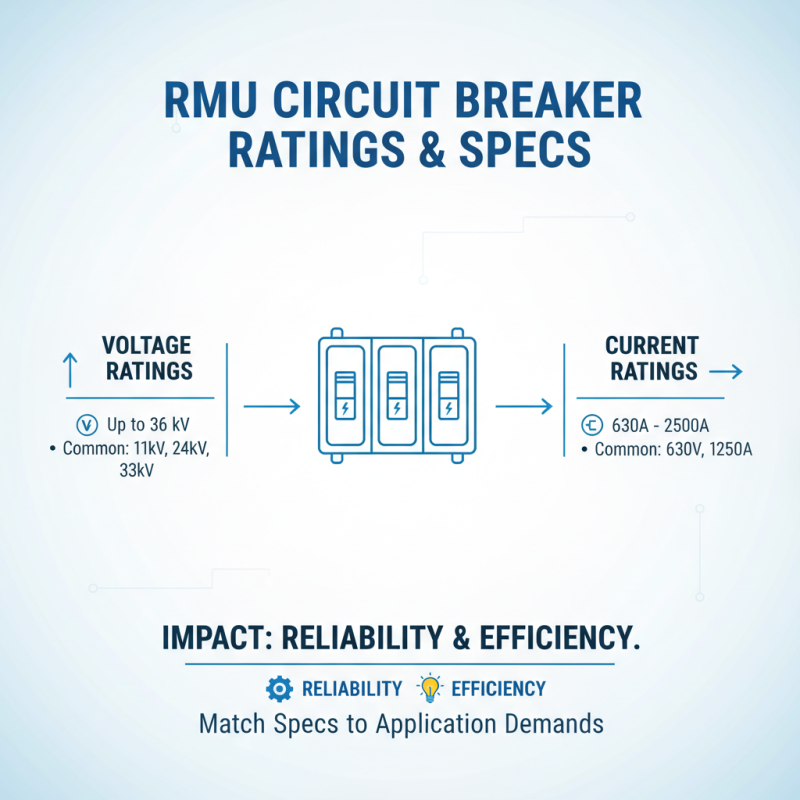
RMU circuit breakers play a crucial role in electrical distribution systems. Their ratings and specifications can significantly impact reliability and efficiency. Typically, RMU circuit breakers are available in different voltage ratings, commonly up to 36kV. According to industry data, the rated current usually ranges from 630A to 2500A. These specifications must align with the application's demands.
When comparing RMU circuit breakers, it’s important to focus on their short-circuit withstand strength. Most breakers offer withstand ratings from 12kA to 25kA, depending on their construction. Notably, the choice of insulation material can influence performance. Vacuum and SF6 insulated types dominate the market. Each type has distinct advantages related to maintenance and environmental impact.
Tip: Always consult updated data sheets from professionals. Specifications change as technology develops. Additionally, understanding local regulations is vital. These can influence which type of breaker is suitable for your projects. Keep in mind that using outdated specifications may lead to performance issues. Evaluating future needs can help prevent costly upgrades.
Trends in Smart Technology Integration for RMU Circuit Breakers
The integration of smart technology in RMU (Ring Main Unit) circuit breakers is rapidly transforming the energy sector. A recent industry report indicates that smart circuit breaker technology can enhance system reliability by up to 30%. These advancements allow for real-time monitoring and automated fault detection, reducing downtime and improving overall efficiency.
Data analytics play a significant role in these innovations. By analyzing usage patterns, energy providers can optimize performance and predict maintenance needs. Studies show that predictive maintenance strategies can lead to cost savings of around 20%. With the incorporation of IoT and AI, RMU circuit breakers are not just reactive but proactive in their response to electrical faults.
Tips: Consider energy efficiency when selecting an RMU circuit breaker. Evaluate how smart features can align with your operational goals. Embrace the data-driven approach; it may unveil hidden inefficiencies in your system. Investing in smart technologies today may save substantial expenses tomorrow.









 Claire
 Mr.Fu
Mr.Fu

 Claire