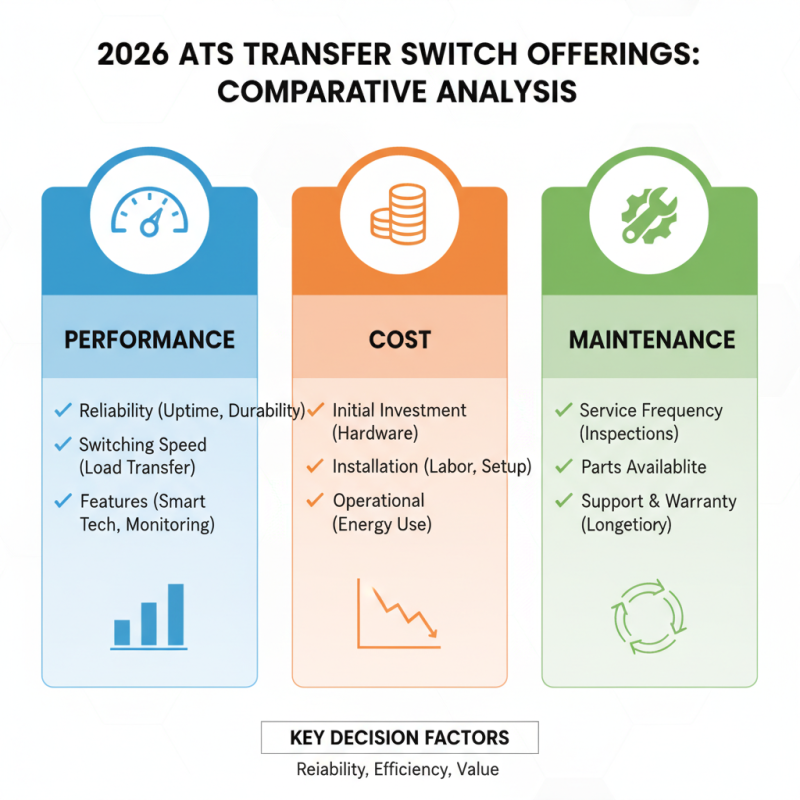
2026 Top Ats Transfer Switch Solutions for Global Buyers?
As the demand for reliable power solutions increases, buyers around the world are seeking the best ATS transfer switch options. ATS transfer switches serve a critical function. They ensure seamless transitions between primary and backup power sources. This capability is vital for businesses, hospitals, and data centers. The reliability of these systems can significantly impact operations and safety.
In 2026, the market offers a diverse array of ATS transfer switch solutions. Each product comes with unique features tailored to different needs. Understanding these distinctions is essential for making informed decisions. However, navigating this landscape can be challenging. Buyers must assess their specific requirements, such as load capacity and transfer speed.
Despite advancements, some solutions may not fully meet expectations. Performance can vary based on brand and model. Buyers should consider reviews and case studies to gauge real-world effectiveness. This research is crucial in selecting the right ATS transfer switch that not only fits budget constraints but also ensures operational reliability.

Overview of ATS Transfer Switch Technology and Its Importance
Automatic Transfer Switches (ATS) play a vital role in power management systems, ensuring continuity during outages. According to industry reports, the global ATS market is expected to reach $3.6 billion by 2026, highlighting its growing importance. These switches allow for seamless power transfer from the primary source to a backup, minimizing downtime for critical infrastructures.
In an era where reliability is paramount, ATS technology is crucial for many sectors, including healthcare, data centers, and telecommunications. Research indicates that over 30% of organizations experience significant downtime due to power failures. This statistic emphasizes why investing in quality ATS solutions is essential for operational resilience. Users need to carefully evaluate their needs, considering factors like required power capacity and switching speed.
However, challenges exist in selecting the right ATS. Some buyers may focus solely on cost, neglecting essential features such as durability and response time. This could lead to inadequate performance in critical situations. Understanding the specific requirements and conducting thorough research can help mitigate these risks. Investing in the right ATS can ultimately enhance operational efficiency and safeguard against unforeseen power disruptions.
Key Features to Consider When Selecting ATS Transfer Switch Solutions
When selecting ATS transfer switch solutions, several key features stand out. Reliability is crucial. A dependable transfer switch ensures a seamless transition during outages. Look for switches that can handle different load types and voltages. This versatility can prevent costly downtime.
Additionally, consider the automation capabilities. Advanced systems allow for remote monitoring and control. This feature enhances operational efficiency and minimizes human error. However, not all automation solutions are foolproof. Regular testing and updates are necessary to maintain system integrity.
Compatibility with existing infrastructure is another vital factor. Each facility has unique requirements, and the selected switch must integrate smoothly. Oversized systems can lead to inefficiencies, while undersized ones may compromise performance. Making the right choice requires more than just product features; it demands careful analysis and active involvement in the decision-making process.
2026 Top ATS Transfer Switch Solutions for Global Buyers
| Feature |
Description |
Importance |
Estimated Cost (USD) |
| Automatic Switching |
Enables automatic transfer during power outages |
High |
$1,500 - $5,000 |
| Load Handling Capacity |
Rated capacity for handling electrical loads |
Critical |
$2,000 - $10,000 |
| Type of Switch |
Can be either mechanical or electronic type |
Medium |
$800 - $3,500 |
| Control Panel Features |
Ease of use for monitoring and manual control |
High |
$600 - $2,000 |
| Safety Features |
Protection against electrical faults |
Critical |
$500 - $1,500 |
| Compliance Standards |
Meets international electrical safety regulations |
High |
Varies |
| Warranty |
Duration and coverage for product defects |
Medium |
N/A |
Top Manufacturers of ATS Transfer Switches for Global Buyers
In the world of power management,
Automatic Transfer Switches (ATS) play a critical role.
They ensure a seamless power supply during outages, but choosing the right manufacturer is vital for global buyers.
According to a recent market report, the global ATS market is projected to reach
USD 5 billion by 2026, growing at a CAGR of
9.1%. This growth reflects an increasing dependency on reliable
power systems across various sectors.
Understanding the key manufacturers is essential.
The industry's leading companies are focusing on innovation and efficiency.
Many integrate advanced monitoring systems. However, discrepancies in quality and service levels can be found
among different manufacturers. Buyers often deal with varying lead times and installation standards,
which can complicate their decision-making process.
Tips: Researching customer reviews can shed light on a manufacturer’s reliability.
Always consider local regulations when selecting an ATS. A report emphasized
that compliance with these can affect installation efficiency significantly.
Exploring multiple options could lead to better deals and performance outcomes.
Future Trends in ATS Transfer Switch Solutions for Global Markets
As the global demand for reliable power solutions grows, the evolution of
Automatic Transfer Switch (ATS) technologies becomes crucial. Future trends
indicate a shift towards smarter, more integrated systems. These innovations are driven by the need for
seamless energy management. Enhanced connectivity features will allow
ATS to communicate better with renewable energy sources, optimizing power distribution.
Emerging markets are increasingly adopting ATS solutions that offer remote monitoring and control
capabilities. This offers greater flexibility and safety. Users can respond quickly to power failures,
minimizing downtime. However, with these advancements comes a challenge: ensuring cybersecurity measures
are robust. Many buyers remain concerned about the vulnerabilities introduced by digital technologies.
The push for sustainability also impacts ATS design. Future solutions must balance
efficiency with ecological responsibility. Buyers face the dilemma of finding systems that minimize carbon footprints while
meeting operational demands. As technology progresses, the best solutions will not only meet current needs but also adapt
to unforeseen challenges. This balance will define the next generation of ATS transfer switch solutions.







 Claire
 Mr.Fu
Mr.Fu

 Claire